
The advertising industry is entering a major transition.
For more than two decades, digital advertising has largely revolved around one concept: keywords. Businesses targeted search terms, optimized bids, improved ad copy, and competed for clicks.
However, the rise of AI assistants like ChatGPT is introducing a completely different advertising environment.
Instead of users typing short searches such as “best CRM software” or “best PPC agency,” people are now having full conversations with AI systems. They explain problems, compare options, discuss budgets, evaluate trade-offs, and seek recommendations.
That shift changes everything.
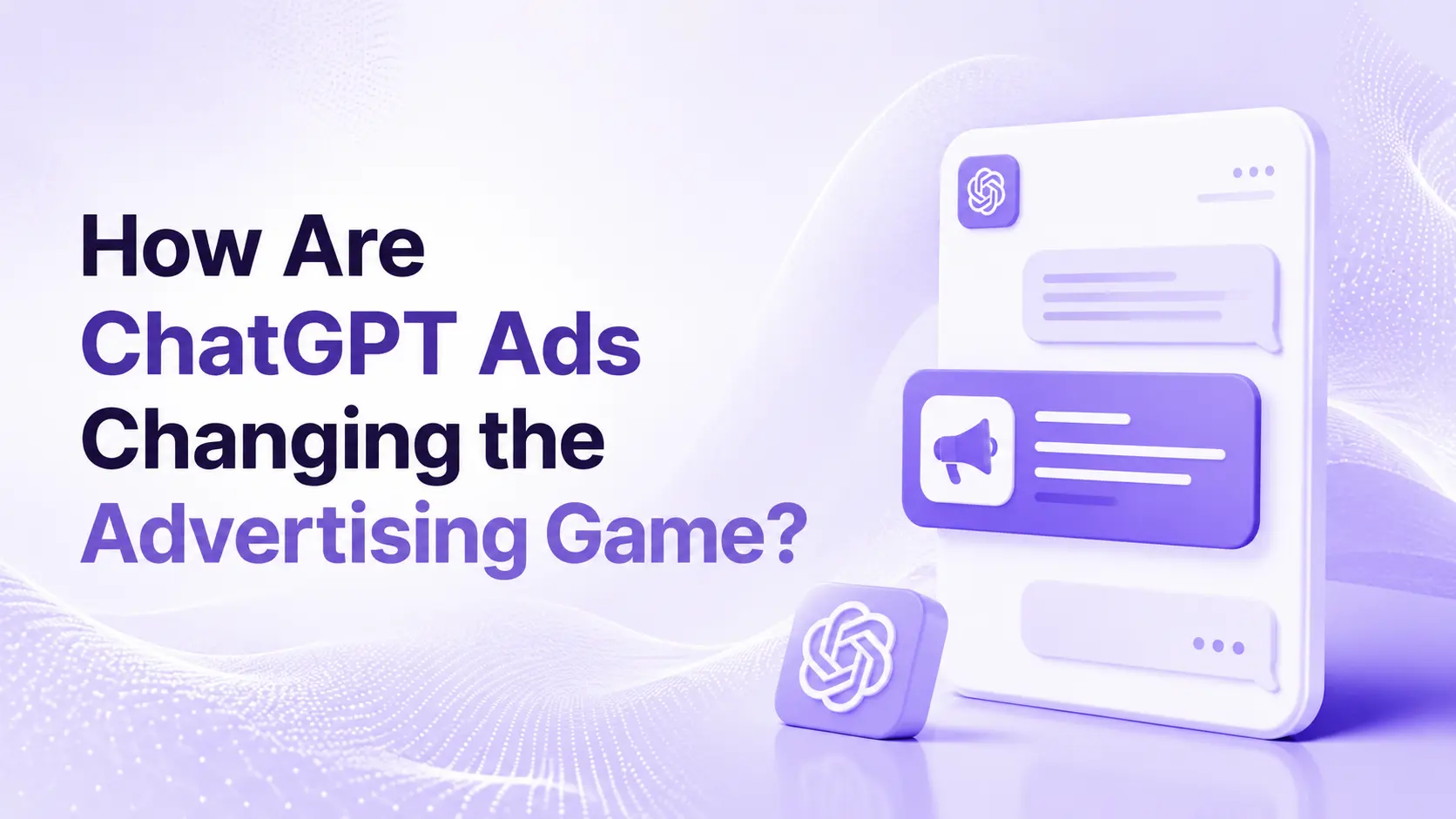
With OpenAI officially launching and expanding ChatGPT Ads, advertisers are beginning to see the emergence of what may become the first truly AI-native advertising platform.
The question is no longer whether AI will influence advertising.
The real question is:
How much of the advertising industry will be rebuilt around AI conversations over the next few years?
What Are ChatGPT Ads?
According to OpenAI’s advertising platform, ChatGPT Ads allow businesses to reach users while they are actively exploring options, comparing alternatives, and making decisions within ChatGPT conversations.
Unlike traditional search advertising, which relies heavily on keywords, ChatGPT Ads are built around conversational context.
OpenAI describes the platform as a way to help advertisers:
- Reach people during decision-making moments
- Go beyond keyword targeting
- Use richer contextual signals
- Deliver ads that feel more relevant within conversations
This is one of the biggest differences between ChatGPT Ads and Google Ads.
Google typically responds to a search query.
ChatGPT responds to an entire conversation.
Why This Is Bigger Than Another Ad Platform
Many advertisers are treating ChatGPT Ads like a new version of Google Ads.
That is a mistake.
The bigger shift is not the ad placement itself.
The bigger shift is the change in user behavior.
For years, users followed a predictable path:
- Search on Google
- Open multiple websites
- Compare options
- Read reviews
- Return to search
- Make a decision
Now the process increasingly looks like this:
- Open ChatGPT
- Ask questions
- Refine requirements
- Compare solutions
- Receive recommendations
- Take action
Instead of visiting ten websites, users may get most of their research completed within a single AI conversation.
That dramatically changes how businesses gain visibility.
The End of Keyword-Only Advertising
Traditional PPC platforms are built around search intent.
For example:
- “Best CRM software”
- “Google Ads agency”
- “Project management tool”
Advertisers bid on these searches because they signal commercial intent.
ChatGPT introduces something more powerful.
Intent develops during the conversation.
Business Insider recently described this as “intent drift,” where a conversation gradually evolves toward a buying decision even when the user did not begin with commercial intent.
For example:
A user may start by asking:
How can I improve my sales process?
The conversation may later evolve into:
- CRM recommendations
- Sales automation tools
- Pricing comparisons
- Implementation advice
That creates advertising opportunities that never existed within traditional keyword targeting.
The AI understands context before the user even searches for a product.
That is a major shift in how intent is discovered.
ChatGPT Ads Are Built Around Conversations, Not Searches
This may become the most important distinction in the future of advertising.
Google Ads typically focuses on:
- Keywords
- Search volume
- Match types
- Search queries
ChatGPT Ads focus on:
- Context
- Conversation history
- User goals
- Decision-making signals
OpenAI explicitly states that richer conversational context allows advertising to become more relevant and useful.
In practical terms, this means advertisers may eventually target:
- Problems
- Needs
- Objectives
- Situations
Rather than individual keywords.
That fundamentally changes campaign strategy.
Why Advertisers Are Paying Attention
Several factors are driving interest in ChatGPT Ads.
Massive User Growth
ChatGPT has become one of the fastest-growing technology products ever created.
With hundreds of millions of users and continued growth, advertisers see enormous potential.
Whenever attention shifts, advertising budgets follow.
The history of digital marketing has repeatedly demonstrated this:
- Search traffic created Google Ads
- Social attention created Meta Ads
- Short-form video created TikTok Ads
Now AI conversations are creating the next advertising ecosystem.
Higher Intent Signals
One of the most valuable aspects of ChatGPT is the depth of information users provide.
Users frequently reveal:
- Goals
- Challenges
- Budgets
- Preferences
- Constraints
- Prior experiences
This level of context rarely exists inside a typical search query.
As a result, advertisers may eventually gain access to stronger buying signals than traditional search advertising offers.
Less Competition
Many industries are already saturated on Google.
High-value keywords can be extremely expensive.
For example:
- Legal services
- SaaS software
- Insurance
- Marketing services
As ChatGPT Ads expand, early adopters may benefit from lower competition before the platform becomes crowded.
The same pattern occurred during the early years of Google Ads, Facebook Ads, and YouTube Ads.
How ChatGPT Ads Could Threaten Google Ads
Google remains the dominant advertising platform.
However, the challenge from ChatGPT is not simply about ad revenue.
The bigger threat is search behavior.
Google’s business model depends heavily on users performing searches.
If users begin making decisions directly through AI conversations, fewer searches may occur.
Fewer searches eventually create fewer advertising opportunities.
Business Insider reports that OpenAI’s advertising model is already being viewed as a potential threat to Google’s traditional keyword-based system.
This does not mean Google Ads will disappear.
Far from it.
Google still owns:
- Search
- YouTube
- Display
- Shopping
- Android
- Maps
However, advertisers should not ignore the possibility that AI assistants may become a significant discovery channel.
The Biggest Advantage of ChatGPT Ads
The strongest advantage is trust.
Users often view AI recommendations differently from traditional advertisements.
When someone asks:
Which project management software should I choose?
The conversation feels more like advise than advertising.
This creates a unique environment where brands can appear during recommendation-driven moments rather than interruption-driven moments.
That could potentially increase engagement quality compared to traditional display advertising.
Some early reports suggest strong engagement metrics within conversational ad placements.
The Biggest Risks Businesses Should Understand
Despite the opportunity, there are important concerns.
Transparency
One of the largest questions involves visibility into how recommendations are generated.
Businesses will want to understand:
- Why certain brands appear
- How ranking works
- How ads influence recommendations
As AI platforms mature, transparency will become increasingly important.
Attribution Challenges
Advertisers already struggle with attribution.
ChatGPT may make this even harder.
A customer could:
- Discover a brand in ChatGPT
- Visit later through Google
- Return through direct traffic
- Convert days later
Determining what truly influenced the sale may become increasingly complex.
Overdependence on AI
Many businesses already rely too heavily on automation.
The rise of AI advertising may accelerate this problem.
Successful marketing will still require:
- Positioning
- Offers
- Branding
- Conversion optimization
- Customer experience
AI can improve delivery.
It cannot fix weak business fundamentals.
OpenAI's Approach to Privacy and Trust
OpenAI appears highly aware of the trust challenge.
The company states that advertising should remain clearly separated from ChatGPT’s answers and that conversations are not sold to advertisers.
OpenAI has also introduced advertising policies that restrict ads from appearing alongside sensitive topics, including areas involving personal vulnerability, harmful content, or high-risk discussions.
This is critical.
If users begin feeling manipulated by AI conversations, adoption of advertising could face significant resistance.
Trust may become the single most important asset in AI advertising.
What Smart Businesses Should Do Right Now
Even though ChatGPT Ads are still evolving, businesses can start preparing today.
Build Brand Authority
AI systems often reference brands that demonstrate credibility.
Invest in:
- Expert content
- Reviews
- Case studies
- Industry authority
- Strong websites
Authority is becoming a marketing asset beyond traditional SEO.
Improve First-Party Data
As advertising becomes more AI-driven, businesses with strong customer data will gain advantages.
Focus on:
- CRM systems
- Lead tracking
- Conversion tracking
- Customer journey analysis
Data quality will become increasingly important.
Focus on Being Recommended
This may become one of the most important marketing shifts of the decade.
Historically, businesses focused on:
How do we rank?
The future question may become:
How do we get recommended?
That requires:
- Better customer experiences
- Stronger reputation
- More useful content
- Demonstrable expertise
AI recommendation engines will likely reward businesses that consistently create value.
My Prediction for the Future of ChatGPT Ads
The biggest misconception is that ChatGPT Ads will simply replace Google Ads.
That is unlikely.
Instead, ChatGPT Ads will create an entirely new category of advertising.
Google owns search intent.
ChatGPT owns conversational intent.
Those are not identical.
Over the next several years, advertisers will likely build strategies across:
- Search engines
- Social platforms
- Video platforms
- AI assistants
The winners will be businesses that understand how consumers move between all of these environments.
My strongest prediction is this:
By 2028, advertising will become more conversational and less keyword-driven.
The brands that adapt early to AI-native discovery, recommendation systems, and conversational buying journeys will gain a significant advantage.
Because the future of advertising may not be about winning the click.
It may be about winning the recommendation.
Why Businesses Will Still Need a Paid Media Specialist in the Age of ChatGPT Ads
Some business owners assume that because AI is becoming more advanced, advertising will become completely automated.
In reality, the opposite is often true.
As advertising platforms become more AI-driven, strategic decisions become even more important.
ChatGPT Ads may automate parts of campaign delivery, targeting, and optimization. However, businesses will still need experts to manage:
- Advertising strategy
- Audience positioning
- Offer development
- Conversion tracking
- Landing page optimization
- Attribution modeling
- Budget allocation
- Cross-channel integration
The businesses that achieve the best results will not simply rely on AI. They will combine AI-powered advertising with experienced human oversight.
How GC Paid Media Helps Businesses Prepare for ChatGPT Ads
At GC Paid Media, we closely monitor emerging advertising platforms and AI-driven marketing technologies, including ChatGPT Ads.
As conversational advertising continues to evolve, our role is to help businesses understand where ChatGPT fits within their overall digital marketing strategy and how it can work alongside channels such as:
- Google Ads
- Microsoft Ads
- Meta Ads
- LinkedIn Ads
- YouTube Advertising
- Retargeting Campaigns
Our approach focuses on more than simply launching campaigns. We help businesses build a complete acquisition system by aligning:
- Ad strategy
- Tracking infrastructure
- Landing pages
- Conversion optimization
- Lead quality measurement
- Revenue-focused reporting
As ChatGPT Ads become available to more advertisers, businesses will need guidance on campaign structure, audience targeting, measurement, and integration with existing marketing channels.
Rather than chasing every new advertising trend, we focus on helping clients determine when a platform is the right fit, how to test it effectively, and how to scale it profitably.
Why Businesses Will Still Need a Paid Media Specialist in the Age of ChatGPT Ads
Some business owners assume that because AI is becoming more advanced, advertising will become completely automated.
In reality, the opposite is often true.
As advertising platforms become more AI-driven, strategic decisions become even more important.
ChatGPT Ads may automate parts of campaign delivery, targeting, and optimization. However, businesses will still need experts to manage:
- Advertising strategy
- Audience positioning
- Offer development
- Conversion tracking
- Landing page optimization
- Attribution modeling
- Budget allocation
- Cross-channel integration
The businesses that achieve the best results will not simply rely on AI. They will combine AI-powered advertising with experienced human oversight.
How GC Paid Media Helps Businesses Prepare for ChatGPT Ads
At GC Paid Media, we closely monitor emerging advertising platforms and AI-driven marketing technologies, including ChatGPT Ads.
As conversational advertising continues to evolve, our role is to help businesses understand where ChatGPT fits within their overall digital marketing strategy and how it can work alongside channels such as:
- Google Ads
- Microsoft Ads
- Meta Ads
- LinkedIn Ads
- YouTube Advertising
- Retargeting Campaigns
Our approach focuses on more than simply launching campaigns. We help businesses build a complete acquisition system by aligning:
- Ad strategy
- Tracking infrastructure
- Landing pages
- Conversion optimization
- Lead quality measurement
- Revenue-focused reporting
As ChatGPT Ads become available to more advertisers, businesses will need guidance on campaign structure, audience targeting, measurement, and integration with existing marketing channels.
Rather than chasing every new advertising trend, we focus on helping clients determine when a platform is the right fit, how to test it effectively, and how to scale it profitably.
The Future Will Belong to Businesses That Adapt Early
Learn more about our ChatGPT Ads agency and management services, including campaign planning, conversational creative, conversion tracking and accountable testing.
Final Thoughts
ChatGPT Ads represent more than a new advertising platform.
They signal a shift in how people discover information, evaluate solutions, and make purchasing decisions.
For marketers, agencies, SaaS companies, ecommerce brands, and service businesses, this is not something to watch from the sidelines.
The advertising industry is moving from search-based intent to conversation-based intent.
And that transition could become one of the most important changes digital marketing has experienced since the launch of Google Ads itself.
Businesses that understand this shift early will be better positioned to compete in the next era of AI-driven advertising.