
TL;DR
- Creative > Targeting – Your ad creatives drive performance more than audience settings
- Use Broad Targeting – Let Meta’s algorithm find the right users
- Keep Structure Simple – Avoid overcomplicated funnels
- Test Creatives Weekly – Scaling depends on creative volume
- Scale Gradually – Increase budgets by 15–30% only after stable results
What Are the Best Meta Ads Practices Right Now?
The most effective Meta Ads strategy in 2026 is:
- Run broad targeting campaigns
- Focus heavily on UGC-style and hook-driven creatives
- Use a simple campaign structure (Prospecting + Retargeting)
- Continuously test and refresh creatives
- Scale budgets only when performance signals are stable
In short: Meta Ads success today is driven by creative quality, not audience complexity.
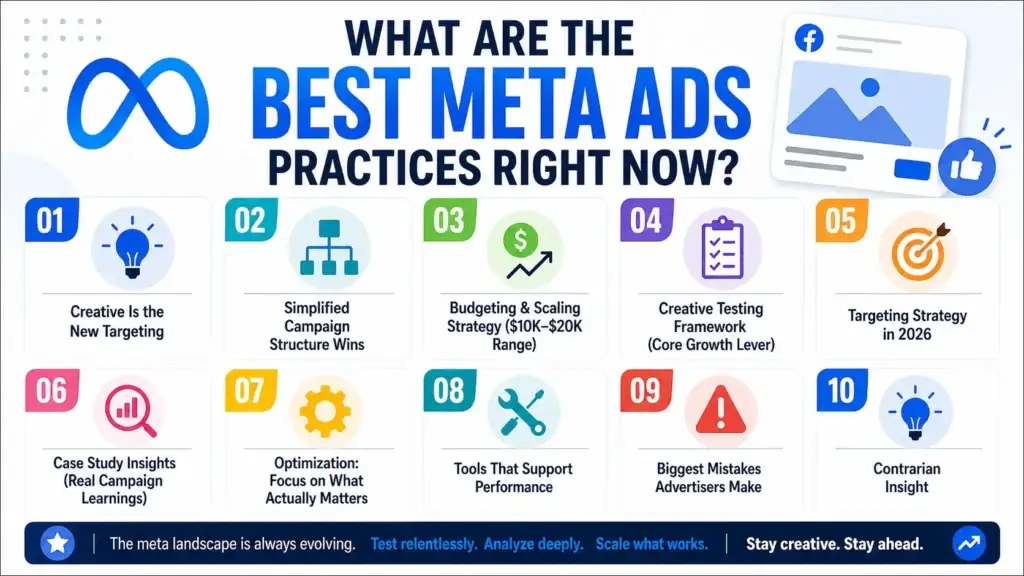
1. Creative Is the New Targeting
Meta’s algorithm has evolved. You no longer need hyper-specific targeting.
What Works Best
- UGC-style videos (authentic > polished)
- Strong hooks in the first 3 seconds
- Problem → Solution storytelling
- Native Instagram Reels-style edits
- Static offer creatives for retargeting
What Fails Today
- Overproduced ads
- Generic brand messaging
- Slow intros with no hook
If your ads aren’t performing, it’s usually a creative issue, not targeting.
2. Simplified Campaign Structure Wins
Over-engineered funnels reduce performance.
Recommended Structure
Prospecting (70-80% budget)
- Broad targeting
- Minimal ad sets
- Conversion-focused campaigns
Retargeting (20–30% budget)
- Website visitors
- Engaged users (7-30 days)
- Add-to-cart audiences
Simpler structures allow Meta to optimize faster and more efficiently.
3. Budgeting & Scaling Strategy ($10K–$20K Range)
For accounts in your working range, scaling discipline is critical.
How to Scale Properly
- Increase budget by 15–30% every 2–3 days
- Scale only when:
- CPA is stable
- CTR is strong
- Frequency is controlled
When to Pause or Adjust
- CPA rises consistently for 3–5 days
- Frequency exceeds ~3–3.5
- CTR drops significantly
Scaling without stability leads to wasted spend.
4. Creative Testing Framework (Core Growth Lever)
Most advertisers under-test.
High-Performance Testing Model
Test:
- Hooks (biggest impact)
- Angles (pain point vs benefit vs urgency)
- Formats (UGC, reels, static)
Weekly System
- Launch 3–5 new creatives
- Kill poor performers quickly
- Scale winning creatives
Growth comes from creative iteration – not just budget increases.
5. Targeting Strategy in 2026
What Works Now
Prospecting
- Broad audiences
- Minimal restrictions
Retargeting
- Website visitors
- Add-to-cart users
- Video engagement audiences
What’s Losing Effectiveness
- Heavy interest stacking
- Narrow audience layering
- Over-segmented funnels
Meta performs best when given more data, less restriction.
6. Case Study Insights (Real Campaign Learnings)
Escape Room Orlando (D2C)
- Focus: Scaling profitably
- Change: Creative refresh + structural simplification
- Result: Improved ROAS and stable CPA
Insight: Creative iteration unlocks scale.
Yoga Studio (Local Business)
- Focus: Increase bookings
- Change: Offer-based creatives + local targeting
- Result: Higher conversions at lower cost
Insight: Local campaigns win with clear offers + simple funnels.
7. Optimization: Focus on What Actually Matters
Key Metrics to Watch
- CTR (creative effectiveness)
- CPA trends (not daily noise)
- Frequency (ad fatigue indicator)
Avoid These Mistakes
- Over-editing campaigns
- Reacting to daily fluctuations
- Changing multiple variables at once
Most accounts fail due to too much interference.
8. Tools That Support Performance
Essential stack includes:
- Meta Ads Manager
- CRM systems
- Tracking tools (Pixel + CAPI)
- Analytics platforms
Accurate tracking is the foundation of profitable scaling.
9. Biggest Mistakes Advertisers Make
- Relying on targeting instead of creatives
- Scaling too aggressively
- Overcomplicating campaign structures
- Ignoring creative fatigue
- Testing too slowly
These are the real reasons campaigns underperform.
10. Contrarian Insight
“Better targeting improves results.” → Not anymore
Reality:
- Creative quality drives performance
- Broad targeting outperforms narrow audiences
- Testing speed beats precision
The best advertisers today win with creative systems not targeting hacks.
Key Takeaways
- Creative is the biggest performance driver in Meta Ads today
- Broad targeting consistently outperforms complex audience setups
- Simple campaign structures allow better algorithm optimization
- Scaling should be gradual and data-driven
- Continuous creative testing is essential for growth
FAQ
A: A creative-first approach using broad targeting, simplified campaign structures, and continuous creative testing.
A: They are less effective than broad targeting combined with strong creatives and Meta’s algorithmic optimization.
A: Ideally, launch 3–5 new creatives every week and optimize based on performance.
A: For meaningful scaling, $10K-$20K/month allows sufficient data for optimization and testing.
A: Increase budgets gradually (15-30%), maintain creative freshness, and monitor key metrics like CTR and frequency.