
Simple Definition
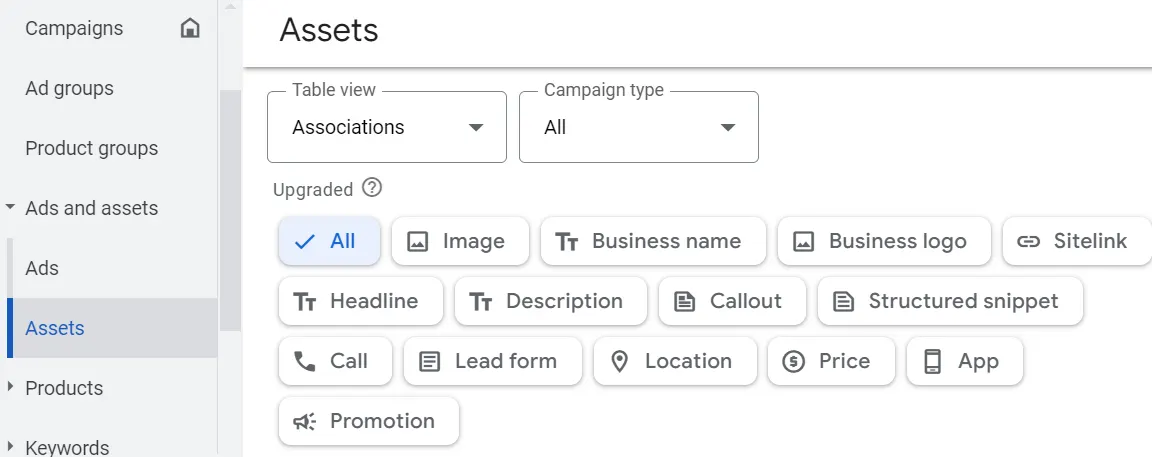
Assets in Google Ads are additional pieces of information attached to your ads, such as sitelinks, phone numbers, pricing, images, promotions, or location details, that expand your ad and improve its performance.
They do not replace your primary ad copy.
They enhance it.
And in modern Google Ads, they directly influence auction competitiveness and predicted performance.
If you previously heard the term “Google Ads extensions,” that is the old name. Google officially renamed extensions to assets, reflecting their growing role in ad optimization.
Why Assets Matter in Modern Google Ads
Google Ads isn’t just “keyword + copy” anymore. In competitive auctions, your ad is judged as a package: your bid, relevance, landing page experience, expected CTR, and the expected impact of assets.
The system now evaluates:
- Bid
- Ad relevance
- Landing page experience
- Expected click-through rate
- Expected impact of assets
This means assets are part of Ad Rank calculations.
Well-structured assets can:
- Increase click-through rate (CTR)
- Improve conversion pre-qualification
- Strengthen engagement signals
- Improve impression share in competitive auctions
Strong assets can help your ad earn more visibility and attract more qualified clicks because they add context (what you sell, why you’re different, what happens next) right on the results page even before a user ever lands on your site.
They don’t automatically lower CPC.
But they improve predicted performance, which improves auction efficiency over time.
That’s a critical distinction.
Practical Example: With vs. Without Assets
Search Query:
“buy insulated casserole online”
Basic Ad Shows:
- 3 Headlines
- 2 Descriptions
Optimized Ad With Assets Shows:
- Product category sitelinks
- “Free Shipping” callout
- “Cast Iron, Stainless Steel” structured snippet
- Image preview
- Price tiers
- Limited-time promotion
- Click-to-call option (if eligible)
That added context:
- Occupies more SERP real estate
- Builds trust faster
- Reduces friction
- Pre-qualifies clicks
- Improves engagement probability
In competitive markets, that difference is significant.
Complete List of Important Google Ads Asset Types
Below are the core assets that consistently drive performance improvements.
1. Sitelink Assets
Sitelinks are additional clickable links below your ad.
Best for:
- Product categories
- Service segmentation
- Pricing pages
- Case studies
- High-intent routing
Performance Insight:
Sitelinks typically generate the strongest incremental CTR lift among all asset types.
Best Practice:
Create campaign-specific sitelinks rather than using generic account-wide ones.
2. Callout Assets
Short benefit-focused text snippets (non-clickable).
Examples:
- Free Shipping
- 24/7 Support
- No Setup Fees
- Certified Professionals
Purpose:
Reinforce value proposition quickly and improve expected CTR.
Avoid duplicating headline copy; callouts should add incremental information.
3. Structured Snippet Assets
Predefined headers that highlight offerings.
Examples:
- Services: PPC Management, SEO, CRO
- Brands: Nike, Puma, Adidas
- Types: Cast Iron, Non-Stick, Stainless Steel
These improve semantic clarity and help Google better understand your product or service depth.
4. Image Assets
Image assets allow visual previews in Search ads.
Most effective for:
- Ecommerce
- Real estate
- Travel
- Home services
- Local businesses
Important:
Accounts must meet eligibility criteria and follow strict image quality guidelines.
When eligible, they often increase engagement and reduce hesitation.
5. Call Assets
Clickable phone numbers attached to ads.
Critical for:
- Local services
- Emergency businesses
- High-intent searches
- Mobile-heavy campaigns
Best practice:
Schedule call assets during business hours only to avoid wasted clicks.
6. Promotion Assets
Highlight limited-time offers.
Examples:
- 20% Off This Week
- Holiday Sale
- Buy One Get One
- Free Gift With Purchase
These pre-qualify traffic and improve conversion rates.
7. Price Assets
Show pricing tiers directly in the ad.
Useful for:
- Ecommerce
- SaaS
- Subscription services
- Tiered services
Benefits:
- Filters low-intent traffic
- Reduces wasted spend
- Improves conversion quality
8. Location Assets
Display physical address information.
Critical for:
- Retail stores
- Restaurants
- Franchises
- Multi-location businesses
They increase trust and store visit likelihood.
9. Lead Form Assets
Allow users to submit contact information directly from the search results page.
Effective for:
- B2B
- Financial services
- Education
- Consultation-based businesses
Best used when landing page friction is high on mobile devices.
How Google Evaluates Assets
Google dynamically assembles ads based on:
- Query intent
- User signals
- Device type
- Historical asset CTR
- Interaction rates
- Conversion feedback loops
Assets are not shown every time.
They are shown when the system predicts performance lift.
This is why asset quality matters.
Generic, repetitive assets often underperform and stop serving.
Realistic Performance Benchmarks
While performance varies by industry, properly structured assets commonly contribute to:
- single-digit to double-digit CTR lifts
- Higher engagement rates
- Improved conversion rate through pre-qualification
- Stronger impression share in competitive auctions
These gains are observed consistently when assets are strategically segmented and monitored.
The Biggest Mistakes Advertisers Make
- Using identical assets across all campaigns
- Duplicating headline messaging in callouts
- Not reviewing asset-level performance reports
- Failing to segment by intent stage
- Ignoring asset scheduling
- Relying entirely on automated assets without oversight
Assets require active optimization, not passive setup.
Advanced Asset Optimization Framework
1. Intent-Based Asset Mapping
Awareness Campaigns:
- Image assets
- Brand-focused callouts
Consideration Campaigns:
- Structured snippets
- Category sitelinks
Conversion Campaigns:
- Price assets
- Promotion assets
- Call assets
- Lead forms
Align assets with search intent.
2. Monthly Asset Performance Review
Monitor:
- CTR per asset
- Interaction rate
- Conversion contribution
- Eligibility status
Pause weak assets.
Introduce variations.
Continuously test.
Treat assets like ad copy.
3. Segment by Campaign Type
Assets should differ for:
- Brand vs non-brand campaigns
- Local vs national targeting
- High-ticket vs low-ticket products
- Mobile-first campaigns
Segmentation increases relevance signals.
4. Combine Manual + Automated Assets
Allow Google’s automated asset suggestions.
However, review performance regularly.
Replace weak automated versions with stronger, manually optimized assets.
Automation helps.
Strategic oversight wins.
Are Google Ads Assets Optional?
Technically, YES.
Strategically, NO.
Ads without assets:
- Occupy less SERP space
- Provide less context
- Have lower engagement probability
- Compete at a disadvantage
In competitive industries, asset optimization is no longer optional; it’s performance infrastructure.
Final Takeaway
If you want better Google Ads performance in 2026:
- Improve conversion tracking first
- Structure campaigns correctly
- Optimize bidding strategy
- And treat assets as strategic growth levers, not decorative add-ons
Because modern Google Ads doesn’t just evaluate your headlines.
It evaluates the entire asset ecosystem attached to your ad.
And the advertisers who optimize that ecosystem win the auction more often.
Assets are additional information added to ads – like links, images, offers, phone numbers, or highlights – to improve visibility, relevance, and performance.
Yes. Well-optimized assets typically increase CTR, improve ad relevance, and can reduce effective CPC while improving conversion potential.
Sitelinks, callouts, image assets, structured snippets, and call assets generally deliver the strongest impact depending on campaign goals.
Not mandatory, but strongly recommended. Ads without assets usually perform worse compared to competitors using them.
Use multiple relevant assets per campaign. Variety improves eligibility, visibility, and testing opportunities.
Yes, Google can auto-generate some assets, but manual optimization usually delivers better control and performance.